€100 into Savings vs Pension

Some clients prefer to save directly into a savings plan, rather than a pension, mostly due to ease of access. With a pension you could be required to wait until your sixties to access funds, so the limitations are not the same as with a savings plan.

At times it is hard to show people the benefit of long-term savings in a pension, as the tax relief on pension contributions and the tax-free growth on pension plans isn’t always obvious. So, let’s see if we can give it a go today.

As an example, let’s look at a person, who wants to invest/save €100 a month for 30 years in an investment savings plan, while trying to match the kind of growth an aggressive pension fund would target. Savings outside of a pension are usually subject to tax on the growth and can be between 25%-41% depending on your investment. Let’s work off 33% tax (same as DIRT tax) on investment growth for this example.

In a pension, if you qualify for tax-relief and are contributing €100 a month, you will get tax-relief of €20 or €40 depending on your marginal tax rate. This means that you will be paying €20 or €40 less tax or to look at it another way, if you chose instead to take that €100 as income (to invest outside of a pension), you would effectively only have €80/€60 in your hand after income tax has been deducted.

For this exercise, I am going to work off the following assumptions.

1.    Saving €100 per month for 30 years, both invested in a fund that has exact same charges and fund return.

2.    Tax-relief on the pension at 20% or 40% and tax-free growth allows a contribution of €125 or €166.67 to your pension for €100 cost.

3.    Gross roll-up tax of 33% tax on the savings plan (you pay growth on tax at end of policy)

After 30 years

Savings value      €67,574

Pension value €103,907 (20%) or €138,546 (40%)

Now, out of the pension you may have to pay some income tax when you are drawing it down. You will currently get a portion of it tax-free and the remainder of the funds are subject to income tax. However, at retirement, most people’s income goes down substantially and in many cases people pay far less or no income tax on their pension deductions. For example, a retired couple over 65 can earn €36,000 income before being subject to income tax.
Automatic Enrolment is expected to start in 2025

The Automatic Enrolment Retirement Savings System is to provide a retirement plan for people without a work or private pension to save for retirement, which will supplement the State Pension.

Why is it being introduced?

*  Not many people have work or private pensions and will only depend on the State Pension when they retire. This means that they may experience a drop in income when they retire which could lead to a fall in their standard of living.

*  Ireland has an aging population, in the future there will be fewer people of working age to support the retired population. To make sure people have enough money when they retire, it is important that people start saving for their future now.

Who will be automatically enrolled?

  • Current and new employees aged between 23 and 60 years of age and earning €20,000 or above per annum will be automatically enrolled.

  • Employees earning below €20,000 per annum and employees aged under 23 and over 60 will be able to ‘opt-in’ to the system.

  • Employer contributions will be limited to a qualifying earnings threshold of €80,000.

How will it work for employees?

~  Unless an employee is a member of a scheme already, contributions during the first six months of membership will be compulsory. Opt out is available after this time and a refund of employee contributions.

~  Members who opt-out will be automatically re-enrolled after two years but will have the ability to opt-out again under the same circumstances outlined above.

~  Invested funds and scheme membership will follow the member when members change employments.

~  Contributions are calculated on your gross salary, starting at 1.5% of your salary and will gradually increase to 6% by year 10. For every €3 that you contribute to your pension fund, your employer will put in €3, and the Government will put in €1. This means that for every €3 you contribute, €7 will be added to your account.

How will it work for employers?

>  Employees will be automatically enrolled with the National Automatic Enrolment Retirement Savings Authority by their employer via payroll software.

>  Employers will be required to make a matching (tax deductible) contribution on behalf of the employee i.e. at a specified contribution rate.

>  Any existing company pension schemes will run parallel to auto-enrolment. Any employees that have a record via payroll of either employee or employer contributions will not be auto-enrolled.

>  Self-employed individuals will not be included in the auto-enrolment scheme.

PLEASE NOTE : This information is correct as of May 2024 - the details of Auto Enrolment are being updated regularly so visit https://www.gov.ie/en/campaigns/0ab04-automatic-enrolment-for-pensions-hub/ for the most recent information.

Do you have more than one pension?

When I am carrying out a financial review with people, I look at all of their finances and quite often there are areas that require further research. One such area is tracking a person’s pension / pensions from older employments.

What I am finding is that people may have forgotten details or don’t have much knowledge about these older pensions. So, I can help them obtain details such as where the policy is being held, what their current options are and making sure that they are clear on the pros/cons of what they can do.

Questions that arise:

  •   Can / should I encash it ?

  •   Can / should I move it ?

  •   Do I lose out by doing anything with it ?

  •   Is my money safe ?

I find some clients leave their pensions in their older employer schemes more out of fear rather than looking at their options and forming a strategy. This leaves them exposed on a number of accounts. There is a chance they may forget about the policy or the pension administrators may not keep in contact with the clients (example: change of clients address or contact details).

In general, the biggest benefit of moving your pension out of a former employers’ pension plan is that you will have direct control over it and you do not need to concern yourself with contacting an extra 3rd party which could include Trustees and/or your previous employer. You can usually move it into a new pension arrangement or a Retirement Bond in your own name.

Depending on a person’s circumstance, it can make sense to preserve the benefits in what is called a Retirement Bond. This is your own personal pension and importantly, it preserves the exact benefits that you would have had in your employers’ pension.

What a lot of people do not realise, is that if you were to move your old pension arrangement into, for example, a PRSA pension plan, you could be missing out on benefits that do not transfer over to a PRSA. A lot of pension schemes have a tax-free lump sum option which is not available in PRSA’s. This means that there may be cases where people are losing out by moving their pension into a PRSA.

Another benefit of a Retirement Bond is that if you have preserved benefits in these plans, you normally have access to them from age 50. If you have merged your pensions together or moved it to an active PRSA, you may have to wait longer to drawdown the benefits.

New Mortgage Protection Practices for Cancer Survivors

A new code of practice for underwriting mortgage protection policies for cancer survivors has recently been launched by Insurance Ireland. This is very positive option and good news for clients who have beaten cancer.

The COP (Code of Practice) is a framework which will allow those who have survived a cancer diagnoses to be exempt from the normal underwriting process for their cancer history in specific circumstances. This means that an applicant will get normal premium rates for their cancer medical history, as opposed to a loading on the rate or other underwriting decision.

The criteria for cases applied for may include the following.

·         New applications should be for mortgage protection, life cover only.

·         The maximum acceptable level of life cover per life, is the lesser of the mortgage amount or €500,000.

·         The application can only relate to primary private residence – first time buyers, home mover and re-mortgages for example (does not apply to second property, holiday or buy-to-let properties).

·         For the mortgage protection cover to be valid the mortgage amount must be drawn down from the lender. So, a mortgage life cover application on its own, without a mortgage being in place cannot be used as family protection cover.

·         The applicant must have ended their cancer active treatment and their cancer must have been in remission for more than 7 years prior to their application.

In order for the process to work in an applicant’s favour, they must disclose their cancer medical history when requested. By not correctly disclosing a cancer history and treatment details when asked, there can be serious implications should a claim occur in the future.

Just on a separate note, some cancer survivors don’t have to have ended treatment or be in remission longer than 7 years to be able to get life insurance cover. I have previously set up a life protection policy for a cancer survivor who had successfully claimed on a Specified Illness policy some time before.


Do I have enough Life Assurance cover?

It is understood that if you plan to purchase a property in Ireland, you will be required to have a Mortgage Protection policy in place. This policy is used to pay back the mortgage loan amount in the event of death.

Is Mortgage Protection enough life cover? Depending on your age and whether you have a family or dependents, then no, Mortgage Protection alone is regularly not enough.

Why would I need more Life Assurance cover? A salary coming into a household is used for bills, loans, savings, and other big life events. If this salary ceases in the event of death, a replacement will be needed to cover the shortfall. If you have a young family, you will need more cover as you will need any benefits to last for a longer time.

How much is enough? We tend to avoid thinking about losing our loved ones, let alone the financial consequences. There is more than one way to work out how much life cover you might need. A basic starting point is to multiply your gross salary or your household annual expenses by a factor of eight.

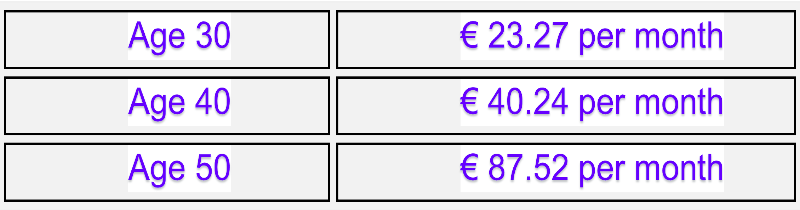
The following Dual Life Assurance quotations are an example of the cost for a couple who are non-smokers and with the option of conversion (this allows you to convert your policy before the term ends to a new policy without the need to provide medical evidence).

The term is for 10 years, and the cover is €250,000. The premiums below cover both lives and is dual cover (meaning the amount of €250,000 will be paid out for each individual life in the event of death).

Sample life assurance quotes December 2023

Sample quotes December 2023

You may require less Life Assurance cover in the case where; your dependents are financially independent, you have death-in-service benefit through your job, you have substantial savings, or you have investments or a property which could provide an income or be sold.

It is beneficial to know that at various times throughout the year, life companies can offer special discounts on premiums to brokers. For example, one company is currently offering 6 months cashback on certain new protection policies.

Redundancy and Tax-Free Lump Sums

I know I have done pieces before on the lines of “why would I need/use a financial adviser” but over the last few months I have engaged clients in a manner where they were delighted afterwards. The general sentiments were “I couldn’t of done that myself, I wouldn’t have known what to do”.

One client was asking me to help with their retirement options. They found the current brokerage looking after their pension were not great at explaining their options. I discussed their options with them, contacted the pension provider on their behalf and was able to get clarification on their Tax free lump sum. There was a question mark over whether they were still entitled to their tax free lump sum because they had signed a waiver when they were made redundant from their employment.

I made our client aware that there is a way of processing your claim that may allow you a pension tax free lump sum, even if you have signed the waiver. This option could be taken away with future pension legislation changes and is not available for all clients, but in this scenario I was able to confirm to my client that we can get her a Tax free lump sum from her pension.

In another situation , a client contacted me about their retirement options. Firstly, for some reason the pension company had not highlighted a tax free lump sum on their options (which I cleared up). Secondly, this client had a particular medical condition which meant I was able to look to get them a better Annuity (pension for life) offer. This is called an enhanced (impaired life) annuity and its basically more money in your pocket for nothing other then confirming your health details. If you meet a certain criteria you can basically get more income for your money.

Most people do not seem to realise that they are very likely paying commission on their policy if there is a broker that is looking after their plans (even if that broker is not advising them). Most pension arrangements have a broker managing them.

I get paid a commission for this service and clarify exactly what I am receiving. Not just that, I generally have been getting as much, if not more, for my clients while being able to provide them with my expertise and relative independence (I do not work with/for one company but have agencies with most of the major Pension/life offices).


Are you 10 years or less away from retiring?

You’ve spent your working life saving and you can almost taste retirement. The decisions you make from here on could have a considerable impact on the size of your retirement savings pot and whether or not you can achieve the required income you need once you stop working.

I work with clients to help them see a snapshot of how their current strategy will look at retirement. If needs be we look at alterations they may need to make to achieve their goals. Here are some of the things we discuss:

1. What are your expenses now and what might they be at retirement?  Although you may be well-practised in budgeting, many people don’t know what income they will need when they retire. Make a budget or get financial planning advice on how to integrate pension savings into a retirement plan. This will also allow you to see how much money you need for everyday life and for additional events such as holidays and hobbies in retirement.

2. What will be your sources of income post-retirement?  Once you’ve got an idea of what income you’ll need, it’s now time to start identifying where your income will come from. There are a few common sources of retirement income, such as pensions, rental income from property, savings, state pension.

3. Make the most of your pension contributions now.  As you’re later in your working life, it’s possible that you’ll be at the peak of your earnings which might make it easier to put extra money into your pension. Many people throw in significant lump sums into their pensions as they get closer to retirement.

4. Check your investments.  Once you get closer to retirement - say 10 years to go – it might suit you to amend your pension portfolio into ‘safer’ or low volatile investments. I heard many stories from the financial crash of 2008 about people who “lost a huge portion of their pension value near retirement”. Part of the problem was that many people didn’t understand where their money was invested or the volatility of their pension strategy.

5. Combine your pensions or maintain separate?  Having your pensions together could make them easier to manage, as well as help you to make more informed choices when it comes to saving for retirement. On the flipside, there are scenarios where it makes more sense for some people to have more than one pension.

6. Start thinking about your retirement options.  Do you know what options you will have with your pensions at retirement? How will that help you achieve your retirement goals?